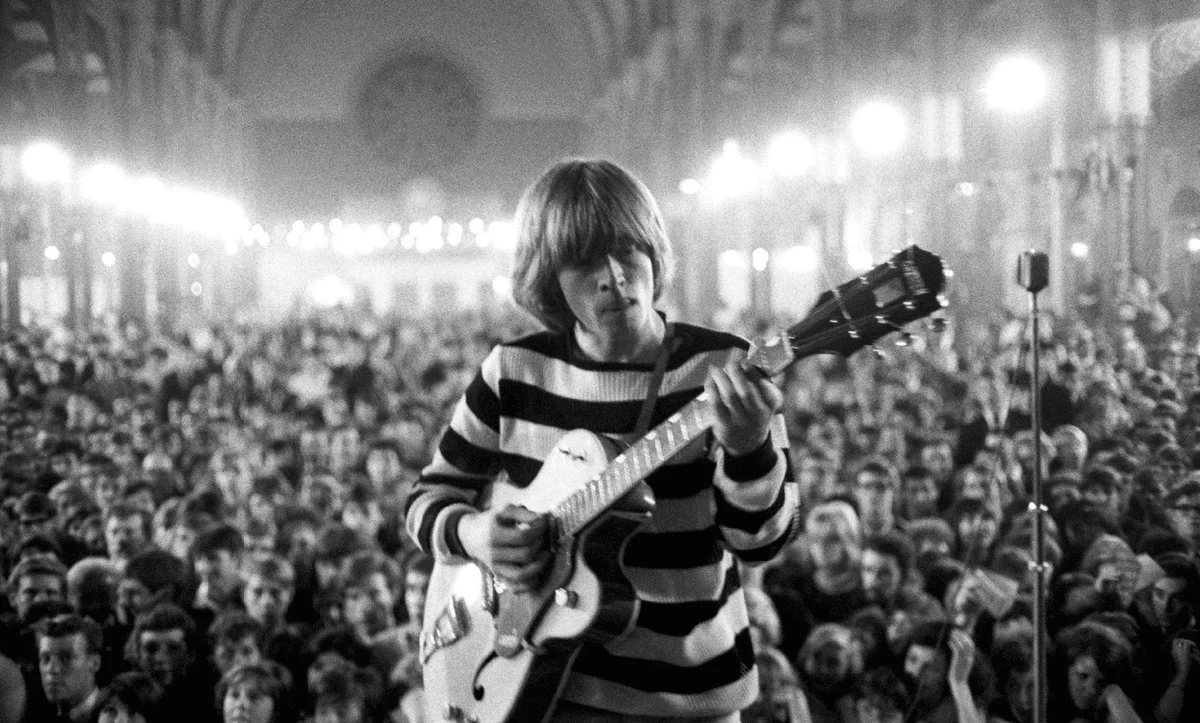
The late 1960s was a time of musical revolution, a golden era when rock and roll was shifting from innocent teenage anthems to something far more complex and dangerous. At the center of this cultural earthquake were The Rolling Stones. While history remembers Mick Jagger and Keith Richards as the band’s driving forces, true music lovers know that the group’s original heartbeat belonged to a troubled young multi-instrumentalist named Brian Jones. He was the golden boy who actually founded the band, named them, and guided their early rhythm and blues sound. Yet, by the summer of 1969, his glittering life came to a sudden, murky end that still haunts the annals of rock history.
Brian Jones was a musical prodigy, capable of picking up almost any instrument—from the sitar on Paint It Black to the marimba on Under My Thumb—and mastering it within hours. His style defined the early aesthetic of the Stones, making them the ultimate bad-boy alternatives to the clean-cut Beatles. However, as the decade progressed, a toxic mix of heavy substance use, fragile mental health, and creative power struggles alienated him from his bandmates. By June 1969, the alienation was complete; Brian Jones was officially out of the band he created. He retreated to Cotchford Farm, a country estate once owned by A.A. Milne, hoping to rebuild his life.
Peace was not what he found. On the warm night of July 3, 1969, weeks after leaving the group, twenty-seven-year-old Brian Jones was discovered motionless at the bottom of his illuminated swimming pool. His girlfriend dragged him out, but it was too late. The coroner’s report ruled his passing as death by misadventure, citing drowning under the influence of alcohol and drugs. For the public, it seemed like another tragic casualty of the era’s excessive rock star lifestyle. But for those who knew him, the official explanation felt far too simple for such a complex tragedy.
Almost immediately, whispers of foul play began to circulate. The focus of these rumors was Frank Thorogood, a contractor hired to renovate the estate who was one of the last people to see the musician alive. Over the years, stories emerged of physical confrontations and financial disputes between the two men. Decades later, on his deathbed in 1993, Thorogood reportedly confessed to a friend that he had indeed killed the rock star in that pool. These chilling allegations transformed a sad accident into a legendary conspiracy.
Today, Brian Jones remains one of the founding members of the infamous 27 Club, a tragic pantheon of brilliant artists who left us far too soon. When we listen to those classic records today, his genius still rings out in every innovative note. His tragic end serves as a haunting reminder of the steep price of fame in an era that burned incredibly bright but incredibly fast. Do you remember when you first heard his music, and what is your favorite contribution from the legendary Brian Jones?