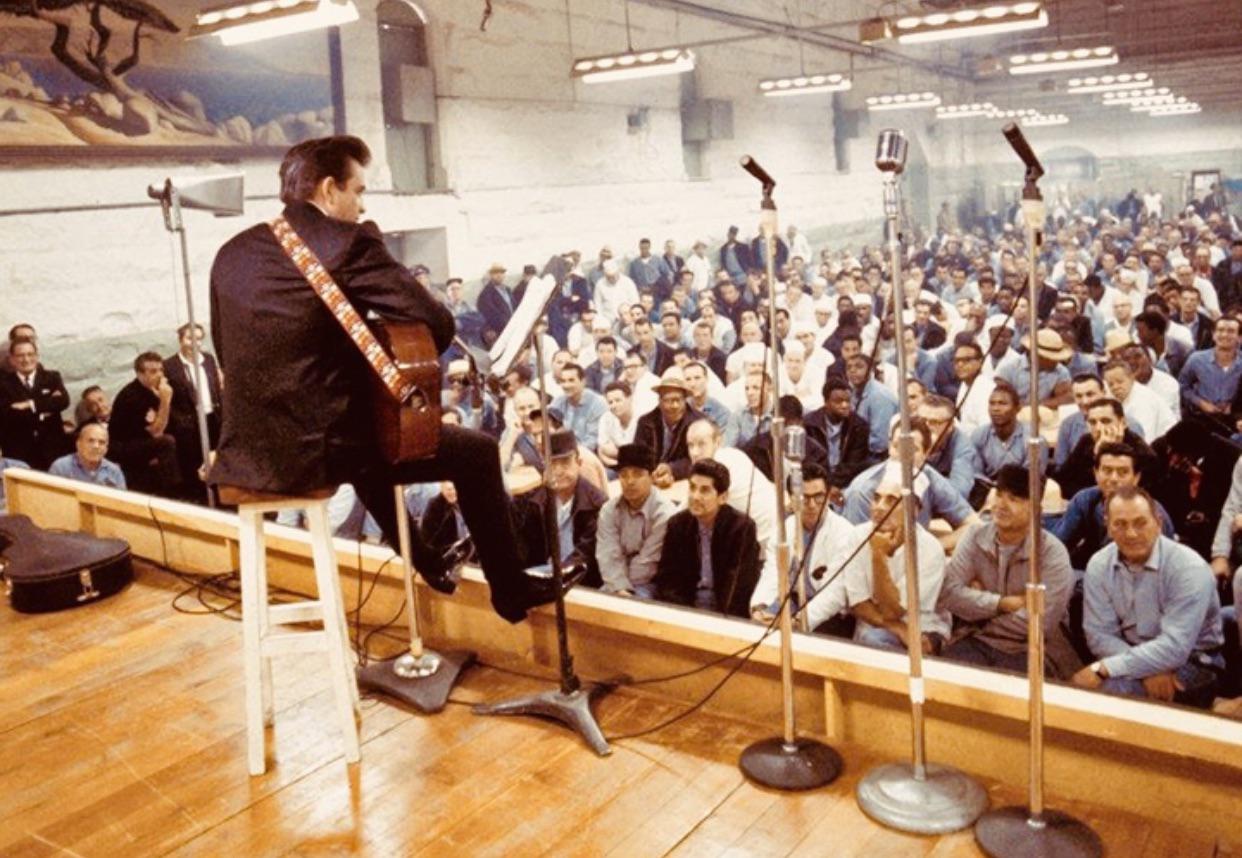
In January 1968, the cold stone walls of California’s Folsom State Prison echoed with a sound that would change music history forever. A tall, rugged man in black walked onto the cafeteria stage, cleared his throat, and said four simple words: Hello, I’m Johnny Cash. At that moment, his career was on life support. To the public, he was a volatile, drug-addled star whose hits had dried up. To the record executives, he was a liability who was spinning out of control. But to the men locked inside those gray walls, Johnny Cash was something else entirely. He was one of them.
Before that fateful day, Johnny Cash was rapidly self-destructing. Pill-popping, canceled concerts, and a highly publicized divorce had tarnished his image. Columbia Records was ready to drop him, weary of his unpredictability and flagging sales. His wild antics, including accidentally starting a forest fire and spending nights in local jails, made him a pariah in mainstream country music. Desperate for a spark to reignite his dying career, Johnny Cash pitched an outrageous idea that his record label vehemently opposed: recording a live album in front of maximum-security inmates. They thought it was commercial suicide.
But Johnny Cash understood something his detractors did not. He knew that the forgotten souls inside Folsom Prison shared his own darkness, his own regrets, and his own longing for redemption. When he stepped on that stage, he did not look down on his captive audience. He sang with a raw, blistering energy that mirrored their anger and isolation. When he performed Folsom Prison Blues, the crowd erupted, recognizing a kindred spirit who was not afraid to peer into the abyss. He spoke to them not as a distant celebrity, but as a fellow flawed human being.
The resulting album, At Folsom Prison, became an instant, roaring success that defied all industry expectations. It catapulted Johnny Cash back to the top of the charts, outselling even the Beatles at the time. The raw authenticity of the recording, complete with the clinking of metal trays and the raucous cheers of prisoners, captured a lightning-in-a-bottle moment. This was not just a clever promotional stunt; it was a visceral, cultural phenomenon that challenged how America viewed its incarcerated population and redefined the boundaries of country and rock music.
Decades later, the legacy of that chilly winter day in 1968 still reverberates through American music. It proved that true art is born out of vulnerability, rebellion, and a willingness to stand in the darkest corners of society. Johnny Cash did not just play a prison show to save his own skin; he gave a voice to the voiceless and turned a bleak penitentiary into an everlasting symbol of redemption. It remains a stark reminder of the time a desperate outlaw walked into a prison and walked out as a towering, immortal legend.
Do you still remember the first time you heard the roaring train whistle of Johnny Cash singing live from Folsom Prison?