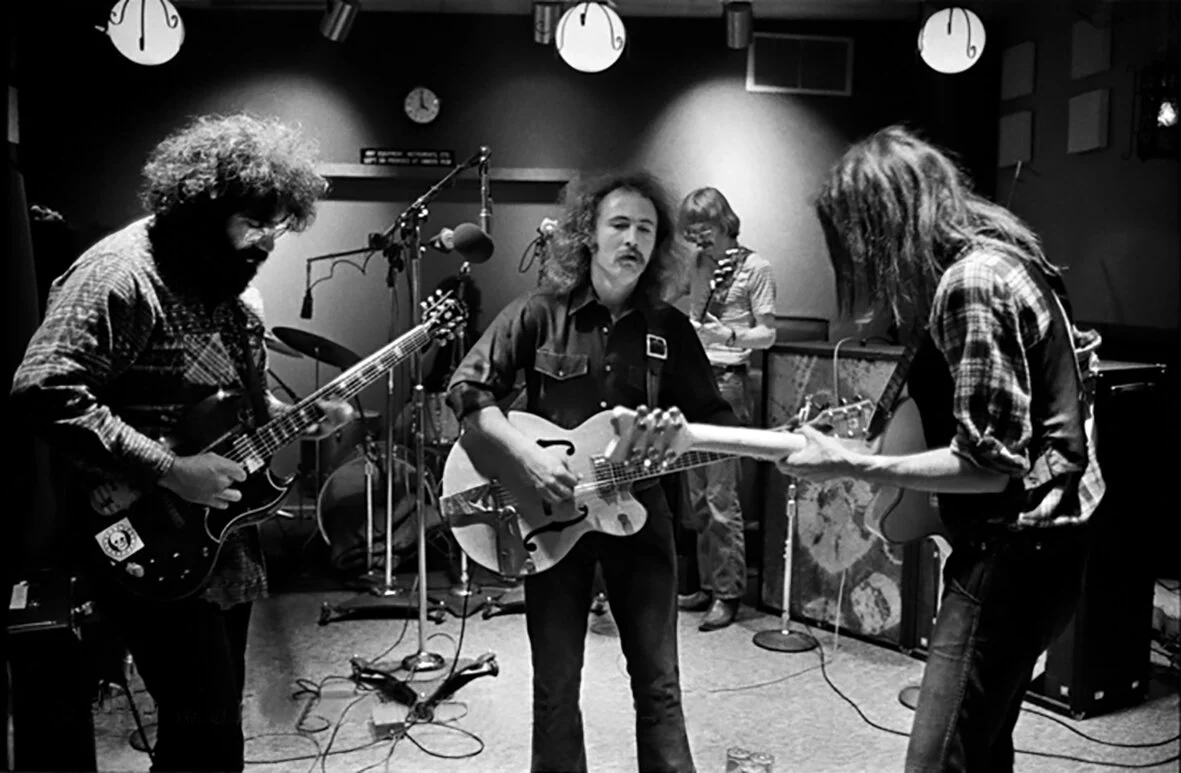
In 1965, the San Francisco air was thick with a strange, transformative energy that felt less like a music scene and more like a fever dream. While the rest of America was still humming along to radio-friendly pop, a group of long-haired experimentalists known as The Grateful Dead were retreating into the shadows of Ken Kesey’s wild Acid Tests. These were not concerts in the traditional sense; they were immersive, mind-altering laboratories where the boundaries between the performer and the audience dissolved into a swirling vortex of strobe lights and collective consciousness. This was the birth of a legend that would redefine the American sound, turning the chaotic spirit of the sixties counterculture into a permanent musical legacy.
To understand The Grateful Dead, one must look past the later stadium tours and focus on those gritty, formative days when the band served as the house ensemble for Kesey’s LSD-fueled gatherings. The Grateful Dead didn’t just perform songs; they acted as conduits for a chaotic, improvisational energy that bordered on the shamanistic. Guitarist Jerry Garcia and his bandmates were pioneers of a sound that refused to be contained by the three-minute limit of a jukebox single. Instead, they stretched time itself, weaving psychedelic tapestries that felt like they were being spun in real-time, right before the eyes of an audience that was frequently as uninhibited as the band members themselves.
This era was the crucible of the counterculture. The Grateful Dead captured the restless, anti-establishment pulse of a generation desperate to break away from the rigid normalcy of the post-war American dream. Their music served as the soundtrack to a massive social experiment that questioned authority, spirituality, and the very nature of human perception. While other bands of the era were busy chasing the top of the Billboard charts, The Grateful Dead was busy building a community—a nomadic, devoted family that would eventually become known as the Deadheads, forever changing how we view the relationship between artists and their followers.
Yet, this revolutionary spirit came with a heavy price. The lifestyle that fueled their creativity often pushed them toward the jagged edges of self-destruction. The pressures of fame, the relentless touring cycle, and the constant exposure to the darker side of the psychedelic era created an environment that was both exhilarating and profoundly dangerous. Beneath the hazy, kaleidoscopic surface of their records lay a deep, complex emotional struggle that reflected the internal fractures of the entire generation. The Grateful Dead mastered the art of balancing this existential weight with a sense of childlike wonder, creating music that could feel both hauntingly tragic and life-affirmingly beautiful.
Even today, the echo of those 1960s experiments remains undeniable. Whenever a band takes the stage to push the limits of improvisation or when a community forms around the shared love of a specific sound, the spirit of The Grateful Dead is present. They remain a timeless reminder that music is most powerful when it stops being a mere product and starts being an experience. As we look back, it is clear that they didn’t just change rock and roll; they mapped out a new way to experience the world, inviting us all to keep dancing, even when the lights finally begin to fade.