He sang about shooting a man in Reno just to watch him die. He crooned about life behind bars, about the weight of chains and the ache of a caged soul. Yet Johnny Cash had never spent a single night in prison. So how did one of America’s greatest country singers become the unlikely savior of thousands of real inmates? The answer lies in one of the most transformative performances in music history: the legendary 1968 Folsom State Prison concert that would resurrect Cash’s career from the ashes of addiction and despair.
By the late 1960s, Johnny Cash was a washed-up has-been. His marriage was crumbling, his drug addiction—particularly amphetamines and barbiturates—had spiraled into self-destruction, and Nashville had turned its back on him. Radio stations refused to play his records. Las Vegas venues cancelled his shows. He was nearly broke, barely relevant, and descending deeper into darkness with each passing day. Many believed the Man in Black was finished. But Cash, ever the contrarian, saw an opportunity where others saw only ruin. He would perform at Folsom Prison in California, a place so infamous it had become synonymous with hopelessness itself.
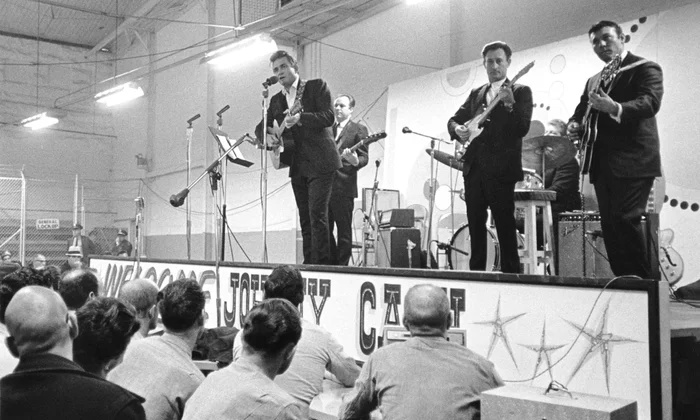
What happened on January 13, 1968, inside those gray concrete walls became pure magic. Johnny Cash walked into that prison yard facing over two thousand hardened inmates—murderers, thieves, lifers—and something extraordinary occurred. As he belted out those familiar lyrics about shooting a man and the chains of incarceration, the prisoners didn’t see a fraud or a poser. They saw themselves. They saw someone who, through his music and his willingness to stand beside them, understood their pain in a way the outside world never could. The connection was raw, genuine, and electrifying. Cash performed with an intensity and authenticity he hadn’t shown in years, feeding off the desperate energy of men who had nothing left to lose.
The album recorded that day, “Johnny Cash at Folsom Prison,” became a cultural phenomenon. It climbed the charts, won Grammy Awards, and reminded America why they had fallen in love with Johnny Cash in the first place. More importantly, it salvaged his career at a moment when it seemed irretrievable. But the true significance lay deeper than commercial success. By performing at Folsom, Cash bridged a chasm between the respectable world and the forgotten, between the free and the caged. He legitimized the humanity of prisoners at a time when society wanted to forget they existed.
What made this moment even more poignant was the irony that Cash himself had never experienced prison, yet his songs about incarceration resonated because they came from emotional truth, not literal truth. His battles with addiction, his personal demons, and his brush with the criminal justice system had given him credibility where it mattered most. He was singing about spiritual imprisonment, about being trapped by circumstances and choices, about redemption and survival. The inmates understood that language perfectly.
More than five decades later, that 1968 Folsom Prison concert remains a touchstone moment in American music history. It reminds us that authenticity transcends facts, that empathy can bridge any divide, and that music has the power to heal the deepest wounds. Johnny Cash proved that you don’t need to have lived someone’s exact life to understand their struggle. You just need to care enough to show up and sing. That concert wasn’t just about reviving a fallen star—it was about reclaiming the humanity of the forgotten and showing that redemption is always possible, even for those the world has written off. For anyone who lived through that era or has discovered Cash’s music since, the 1968 Folsom Prison concert remains a timeless reminder of why the Man in Black will never truly be forgotten.