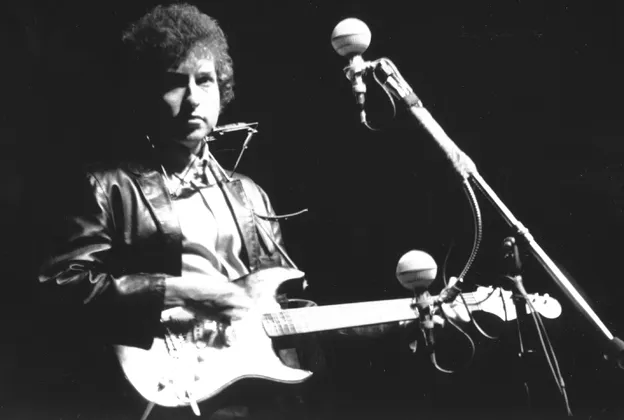
It was July 25, 1965, at the Newport Folk Festival. The air was thick with the scent of summer humidity and the reverence of a crowd that viewed Bob Dylan not merely as a musician, but as a sacred prophet of the acoustic folk movement. They had come to hear the man who wrote the anthems of a generation, the strummer of simple strings and the voice of pure, unadulterated protest. But when Bob Dylan walked onto that stage, he wasn’t carrying his weathered acoustic guitar. Instead, he brandished a Fender Stratocaster, a jagged instrument of rebellion that seemed to spit in the face of everything his purist audience held dear. As the first amplified chords tore through the humid night, the sound was less like music and more like a declaration of war.
The reaction was instantaneous and visceral. The folk purists, who considered themselves the guardians of traditional integrity, felt as though they had been sucker-punched. They didn’t just dislike the change; they felt personally betrayed. Boos erupted from the front rows, drowning out the performance and turning the concert into a chaotic spectacle of shock and indignation. To those in the crowd, Bob Dylan had abandoned his roots, trading his poetic authenticity for the abrasive, commercial lure of rock and roll. It was a moment of profound cultural rupture, a tectonic shift that echoed far beyond the fairgrounds of Newport.
Yet, looking back through the crackle of vintage vinyl and the lens of history, we see that night differently. Bob Dylan was never meant to be a static icon for the folk movement to parade around. He was an evolving artist, restless and hungry for a new sonic vocabulary. By plugging in that guitar, he wasn’t just performing a set; he was effectively killing the folk era and ushering in the birth of modern rock. He refused to be the poster boy for someone else’s expectations, choosing instead to risk his credibility in pursuit of a heavier, more complex sound. That decision to ‘go electric’ remains one of the most audacious gambles in the history of American music.
What makes this story resonate so deeply even today is the raw human tension behind the spotlight. We often imagine these legends as untouchable gods, but in 1965, Bob Dylan was a young man dealing with the crushing weight of being a hero to a public that wanted him to stay exactly as they had first discovered him. The pressure to conform, the fear of losing one’s artistic voice, and the painful necessity of shedding an old identity—these are themes that still ring true for any musician or dreamer who has dared to evolve.
Was it an act of artistic genius or a reckless act of defiance? The debate among classic rock enthusiasts still flickers like a dying ember. The Newport incident serves as a poignant reminder that true innovation rarely comes without a cost. When you look back at that grainy footage, you are witnessing a pivot point where the world changed. Bob Dylan eventually moved on, leaving his acoustic prophet status in the dust, but the echo of those amplified chords still rings loud in the history of rock and roll. Sometimes, to find a new path, you have to be willing to walk off the stage of public opinion.