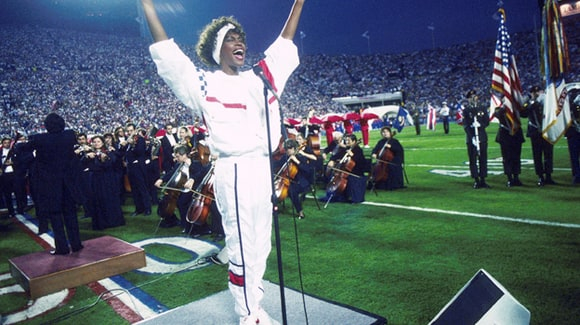
In January 1991, the mood across America was heavy with deep anxiety. The country had just entered the Persian Gulf War, and families watched the evening news with bated breath, fearing for loved ones sent overseas. When Super Bowl XXV kicked off in Tampa, Florida, the football game itself felt secondary to the palpable tension hanging over the stadium. Security was unprecedentedly tight, and the air was thick with worry. Yet, in one single, soaring moment, a twenty-seven-year-old superstar named Whitney Houston stepped up to the microphone and completely stopped the nation in its tracks, turning wartime dread into pure, unforgettable goosebumps.
Dressed not in a glamorous evening gown, but in a simple white, red, and blue tracksuit with a matching headband, Whitney Houston looked remarkably down-to-earth yet completely radiant. As the first notes of the orchestra swelled, she took a deep breath and delivered a rendition of The Star-Spangled Banner that would forever change how the anthem was sung. Instead of the usual rigid march, she infused the patriotic song with soulful gospel inflections, stretching the tempo to a dramatic four-four time signature. Her voice did not just carry across the stadium; it seemed to wrap around a frightened country, offering a moment of fierce unity.
However, behind the scenes of this legendary moment lay a wave of intense drama and controversy that threatened to overshadow her historic triumph. Immediately after the game, rumors began to swirl that Whitney Houston had lip-synced her entire performance. Critics and media outlets accused her of miming to a pre-recorded track, sparking a heated debate about authenticity in live television. In truth, due to the extreme logistics of broadcasting a live game during wartime, her music director had insisted on using a pre-recorded vocal track as a safety backup. But those powerhouse vocals were indeed Whitney, recorded in a single, flawless take in a California studio just days prior. Despite the whispering campaigns, the sheer emotional weight of her delivery silenced the skeptics.
The public reaction was so overwhelming that Arista Records decided to release the performance as a commercial single, with all proceeds going to the American Red Cross Gulf Soldier Relief Fund. Against all odds, the national anthem climbed the charts, peaking at number twenty on the Billboard Hot 100, a feat practically unheard of for a patriotic hymn. But the story did not end in 1991. A decade later, when the horrific tragedy of September 11 shook the world, America once again sought solace in Whitney Houston’s voice. The single was re-released, and it quickly shot back onto the charts, peaking at number six. It became a national prayer, reminding a grieving public of their resilience.
Today, Whitney Houston’s legendary performance remains the undisputed gold standard that no artist has ever quite matched. In an era of modern, over-produced halftime spectacles, her simple, powerful performance stands as a timeless monument of pure magic where music transcended war to heal a bruised national psyche. Do you still remember the incredible goosebumps you felt when you first heard Whitney’s voice soar over that stadium?